Hooknetik Blog
Faceless Digital Marketing Without a Presenter
Faceless digital marketing lets brands stay recognizable without a human presenter. Learn channels, formats, disclosure, and what to measure.
By Serdar Senay14 min read
- faceless digital marketing
- virtual influencers
- short-form video
- AI characters
- content disclosure
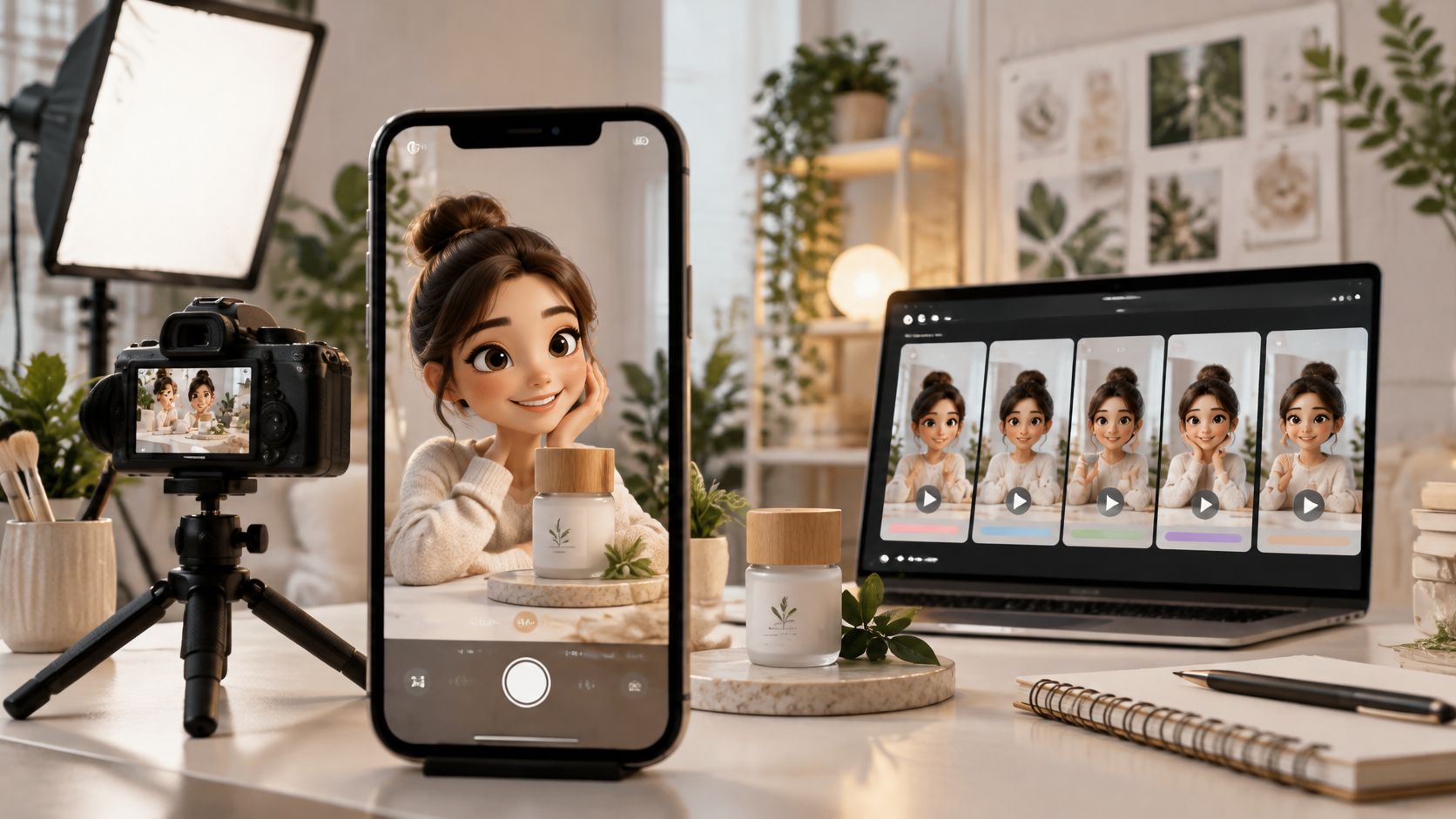
In short
Faceless digital marketing lets brands stay recognizable without a human presenter. Learn channels, formats, disclosure, and what to measure.
You need another product clip for tomorrow, but nobody wants to film it. Your founder's busy, your last creator delivery doesn't match the brand, and the product photos are starting to look repetitive. Posting without a presenter sounds practical, until you realize that removing the person doesn't give you a recognizable brand or a reason for anyone to buy.
Faceless digital marketing works best as a publishing system, not an anonymity trick. You need something viewers recognize, a truthful explanation of what they're seeing, and a way to check whether the content creates business value.
Table of Contents
- Faceless Digital Marketing and Where It Came From
- Channels and Formats That Stay Recognizable
- How a Repeating Character Gets Seen
- When to Label Synthetic and Paid Content
- How to Tell the Clips Earn Their Keep
- Start One Recognizable Series This Month
- Questions Brands Still Ask
Faceless Digital Marketing and Where It Came From
Faceless digital marketing is branded publishing in which no employee, founder, or hired presenter appears on camera, while the account still reads as one business. The content might use voiceover with b-roll, product-only shots, screen recordings, text-led carousels, or a persistent digital character.
Say you sell jewelry. You could explain necklace layering over close-up footage, publish a carousel comparing lengths, or create a digital stylist who introduces different combinations. The format changes, but your product knowledge, visual style, and responsibility to customers don't disappear.
That's different from an anonymous spam page that conceals who's selling. It also differs from a conventional influencer partnership, where the audience's relationship with a real person is part of what the brand buys.
A production choice inside a larger market
The commercial context helps explain the interest. The 2024 Collabstr influencer marketing report, drawing on 35,000 brands and 80,000 influencers, estimated global influencer marketing at $19.8 billion in 2024, up 13.7%, projected the creator economy from $127.65 billion in 2023 to $528.39 billion by 2030 at 22.5% compound annual growth, and recorded a 93% year-over-year increase in UGC creators.
The same report put global digital-video advertising at approximately $191.4 billion in 2024, with short-form video advertising at $99.43 billion and projected to reach $111 billion in 2025. Those figures describe the broader commercial environment, not the earnings a faceless account should expect.
For a small seller, the useful lesson is simpler: separate the demand for content from someone's willingness to appear on camera. You still need original ideas and product evidence.
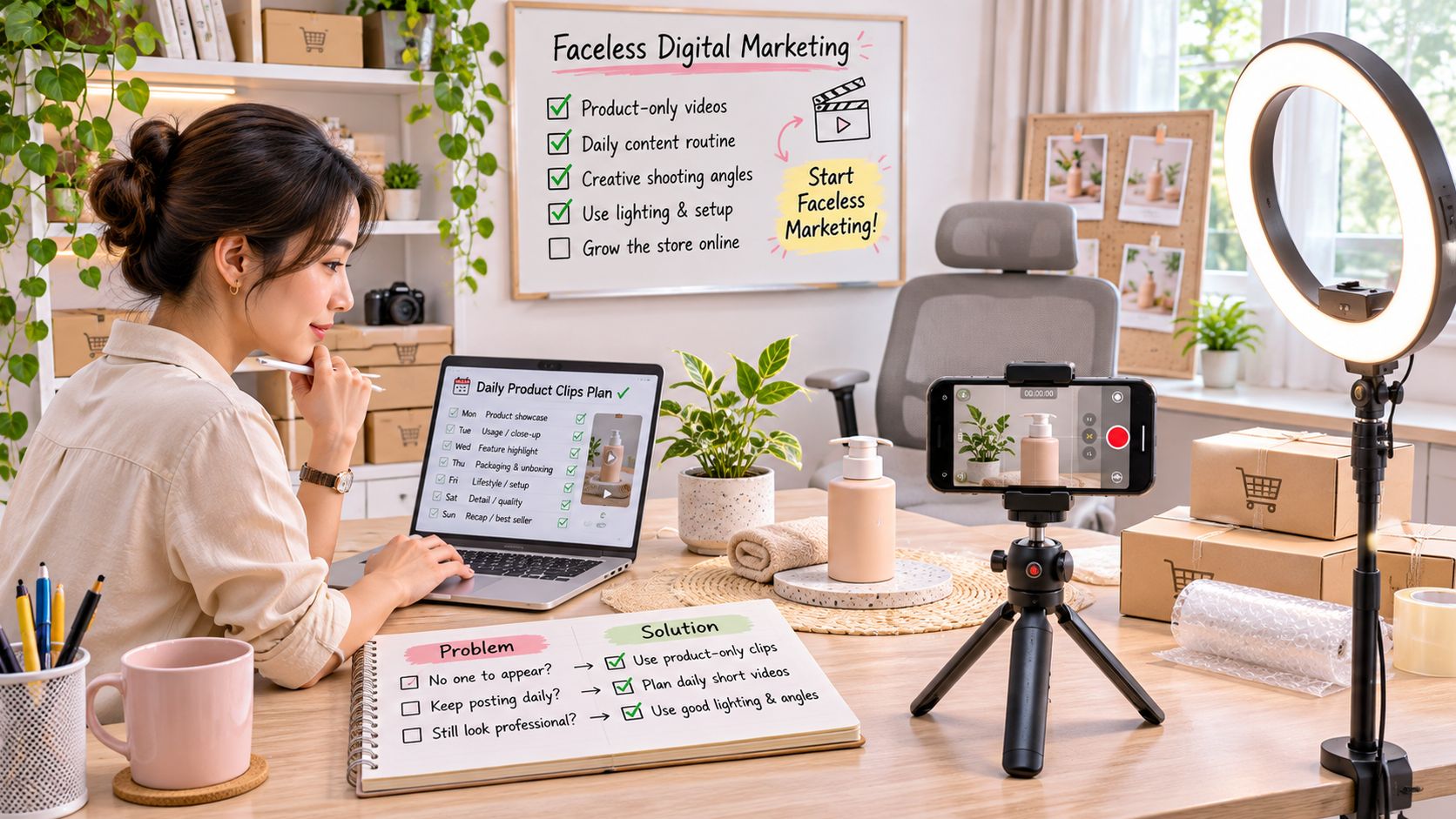
Separating the operator from the public identity
Virtual characters provide a useful history of that separation. A systematic review published by Springer traces examples including Hatsune Miku's Domino's Pizza collaboration in 2013, Lil Miquela's Instagram debut in 2016, treated as the emergence of modern virtual influencers, Noonoouri's Dior campaign in 2018, Lil Miquela's Samsung campaign in 2019, and Imma's IKEA Japan campaign in 2020; it also identifies 73 peer-reviewed articles from 2016 to 2024, with scholarly output nearly doubling in 2021 compared with the preceding three years.
These examples aren't a claim that all faceless marketing began with virtual influencers. Product photography and voiceover advertising belong to a much broader tradition. The important development is the ability to manage a persistent public personality separately from its human operator.
An AI influencer is one way to make that personality repeatable. A small brand can borrow the operating principle without copying a celebrity campaign: choose one face, serve a narrow niche, and plan a month of vertical clips.
The character can carry the identity. A human business must still own the products, claims, permissions, and disclosures.
Channels and Formats That Stay Recognizable
| Format | What stays consistent | Usual home | Best job |
|---|---|---|---|
| Voiceover with b-roll | Brand voice and product shots | TikTok, Reels, Shorts | Tutorials and explainers |
| Product stills and carousels | SKU, logo, and type style | Instagram feed and TikTok photo posts | Catalog browsing |
| Screen recording | Interface and cursor path | Shorts, Reels, LinkedIn | Storefront or software demos |
| Persistent digital character | One face, styling, and cadence | TikTok, Reels, Shorts | Personality-led product video |
| Transferred or template motion | Proven move and reference sound | Vertical short feeds | Fast hook tests of a few seconds |
Read this comparison by asking what the customer needs to understand, not which format looks most advanced. A skincare seller explaining packaging instructions has a different job from a software company demonstrating a checkout integration.
Voiceover with b-roll suits explanations because you can show the relevant detail while someone describes it. For jewelry, that might mean a clasp close-up while the narration explains fastening. The main constraint is having enough clear, accurate footage to support the script.
Product stills and carousels work when buyers need to inspect options. A face can distract from a color comparison or size guide. Keep product names, scale, and visual treatment consistent so customers can compare rather than decode each slide.
Choose by the evidence you can show
Screen recordings are particularly useful when the interface is the product. Record the actual path a customer should take, remove private information, and keep the cursor deliberate. An attractive opening won't rescue a walkthrough that skips the step people find confusing.
A persistent digital character makes sense when personality is part of the presentation. A fictional stylist can introduce an outfit theme, while separate product images provide the detail needed to evaluate the clothing. Don't ask generated imagery to prove fabric texture or fit that you haven't verified.
Transferred or template motion is useful for testing presentation. A short movement can provide an opening without requiring a new filming session, but a familiar camera move isn't evidence that the product works. Check the result for distorted packaging, incorrect proportions, or gestures that hide the item.
For a hypothetical test, you might prepare 4-to-15-second variations, using a longer uploaded reference only for its opening movement. Treat that as a production choice, not a universal ideal length.
Keep recognition separate from repetition
Inside a series, keep these elements stable:
- Identity: Use the same name and face or voice signature.
- Product framing: Make it clear what category you sell and why the item belongs in the scene.
- Caption tone: Keep the same level of formality, vocabulary, and relationship with the viewer.
Change the opening frame, on-screen text, and call to action by platform; posting the identical file everywhere isn't a portfolio.
Sound needs its own review. A reference track may establish pacing, but availability doesn't establish commercial permission. The practical considerations in adding music to a video belong alongside your visual checks, not after export.
For the next month, choose a primary format and a secondary proof format. A character-led clip plus a product carousel is a useful pairing: one introduces an idea, while the other lets buyers inspect what's for sale.
How a Repeating Character Gets Seen
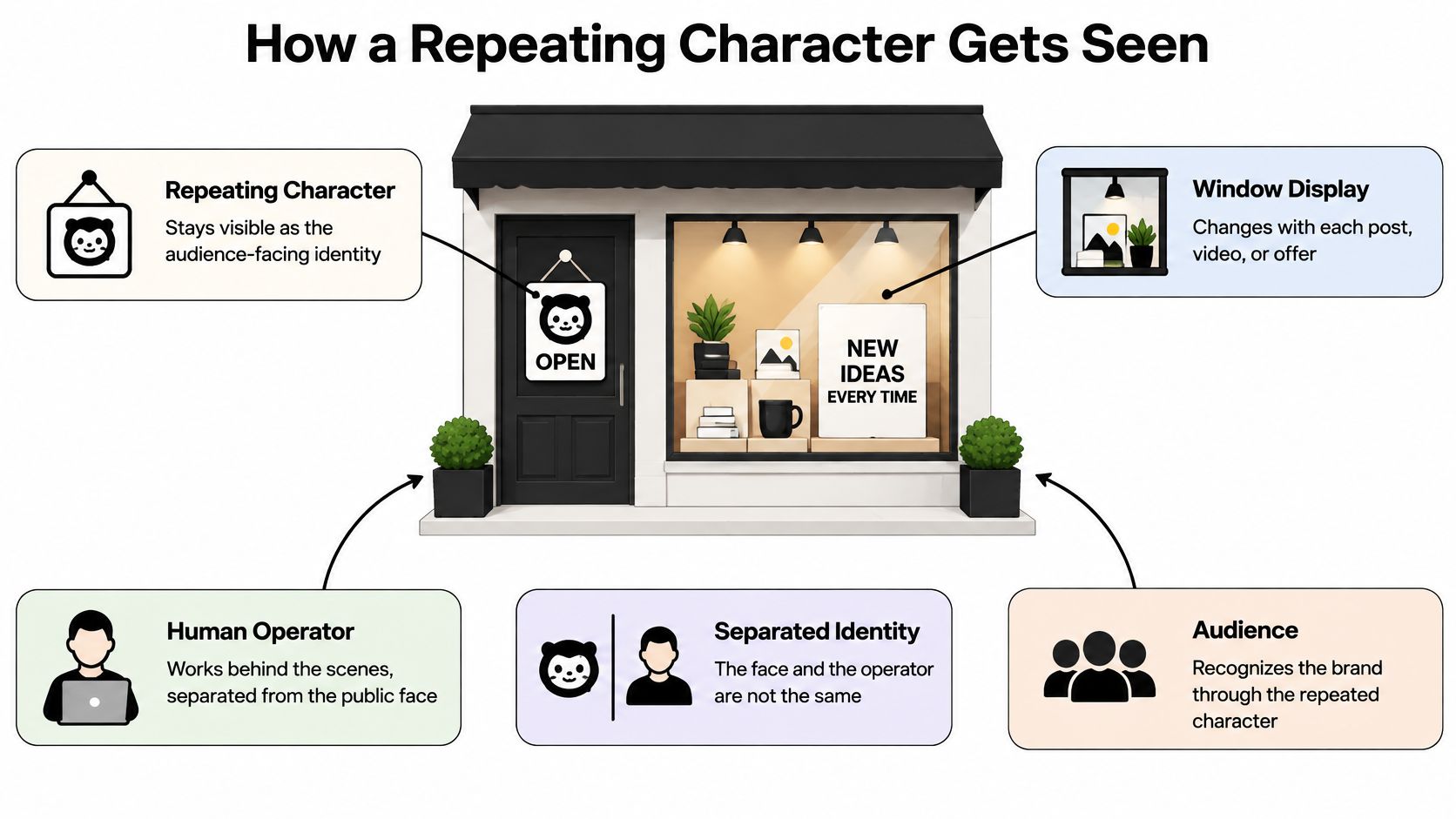
Think of the character as the store sign that stays above the door while the window display changes. Customers recognize the shop, but they still need a reason to stop and look today.
The same distinction applies to a digital personality. The audience-facing identity remains recognizable while the human operator changes the scene, offer, or subject.
This shop metaphor makes the separation visible.
Establish the identity before testing the opening
Start with a written description or a photo your brand owns and has permission to use. Define the face or voice once, then treat outfits and hairstyles as variations of that identity rather than a replacement actor.
For example, a digital fitness host might appear in different training outfits while retaining the same facial identity and speaking style. Product photos belong in clips where they clarify the subject; a personality-focused post doesn't need an item inserted just to fill the frame.
Before choosing avatars to make, decide what the character knows, how it speaks, and what it must never claim. A fictional host can explain a routine, but it shouldn't invent personal experience using a supplement.
Test behavior rather than assuming recognition
The GoViralDev explanation of TikTok's recommendation model groups signals into user interactions, video information, and device or account settings, describing completion, likes, shares, comments, follows, and skips as stronger behavioral inputs than language, country, and device settings.
A synthetic character therefore doesn't need celebrity status to deserve a test. Equally, a familiar face doesn't compensate for an opening that viewers immediately skip.
Use a controlled creative comparison:
- Hold the character and product constant. Keep the offer unchanged too, so a discount doesn't explain the result.
- Change the opening movement first. A product close-up and a character entrance answer different viewer questions.
- Test caption, sound, and clip length separately. Otherwise, you won't know which change helped.
- Compare completion, skips, shares, and comments before adding another character.
For a hypothetical short-clip library, you could test openings within a 4-to-15-second production range and trim a longer reference to its relevant opening. Compare similar lengths when interpreting completion, since finishing a shorter clip requires less viewing time.
The embedded video provides a visual reference alongside this testing approach.
Practical rule: Change the display before replacing the sign.
Keep a visible brand cue, such as packaging, a restrained logo, or a recognizable caption treatment. Recommendation can introduce the clip to strangers, but viewers still need to know whose content they're watching.
When to Label Synthetic and Paid Content
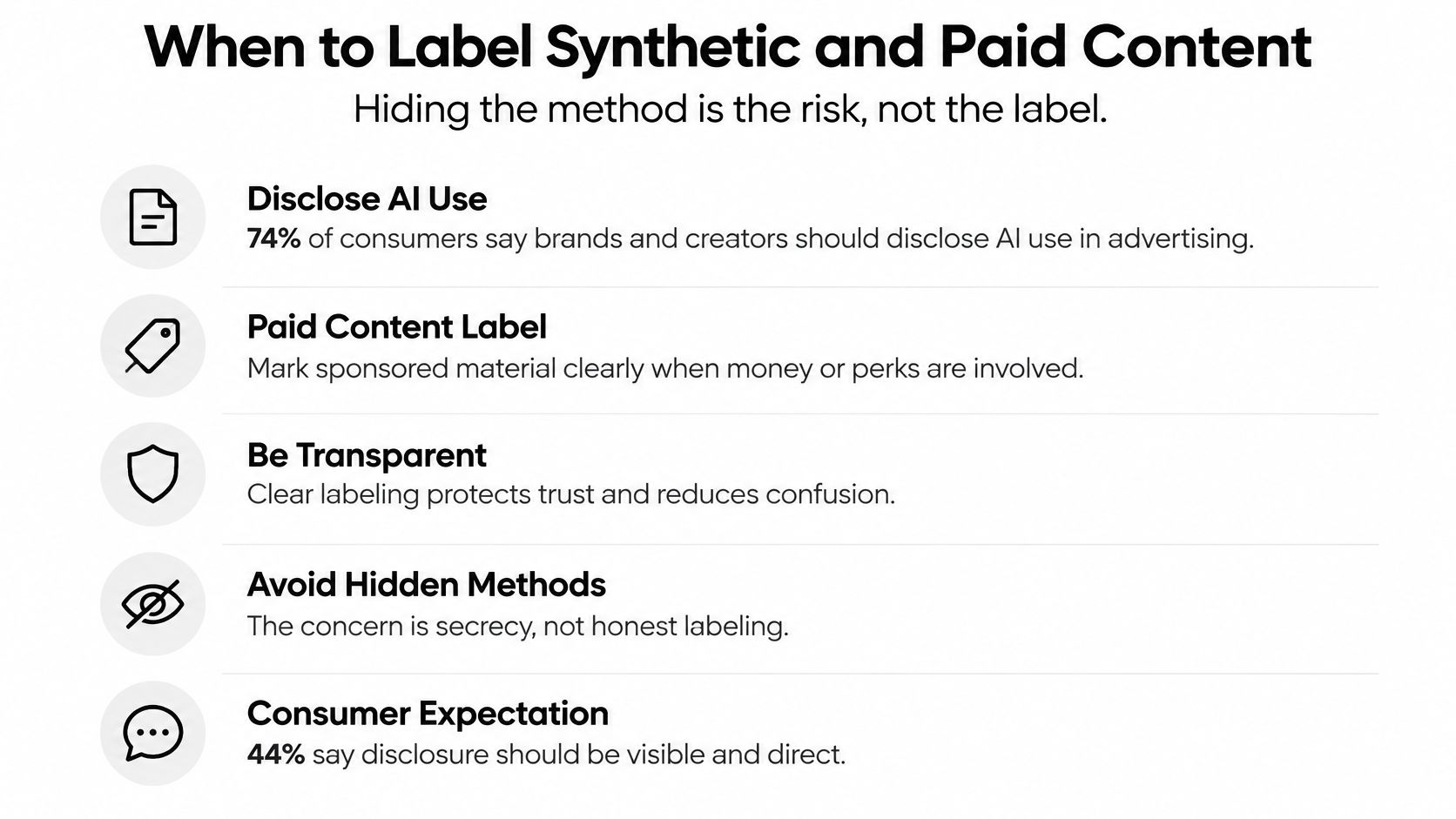
Hiding the method is a risk, not a strategy. U.S. findings described in the Cint report coverage found that 74% of consumers believe brands and creators should disclose AI use in advertising and 44% say undisclosed AI advertising reduces trust, while a cited 2025 study reported negative reactions to creators' AI disclosure from only 0.8% of audiences and 1.7% of brands.
Those findings don't guarantee that labeling improves conversion. They do challenge the assumption that concealment protects performance.
Separate the advertising relationship from the synthetic identity
An AI character isn't automatically an advertisement. The commercial relationship is a separate question: the FTC's social media disclosure guidance identifies payment, free or discounted products, employment, and personal or family relationships as material connections that viewers may need to know about, and warns against disclosures hidden behind an expanded caption.
Use direct language such as Ad, Sponsored, or Paid partnership where viewers will notice it. The FTC's guidance on clear and conspicuous disclosures places responsibility on both brands and endorsers and cautions against vague expressions such as thank-you messages, #partner, or #sp.
On TikTok, the commercial-content disclosure guidance requires the disclosure setting for content promoting a brand, product, or service, including relevant brand tags, logos, demonstrations, and tutorials. The publisher must apply that setting when uploading, even if the video was generated earlier.
Make the synthetic presenter understandable
Add a distinct synthetic-identity explanation when viewers could mistake the character for a real person. Put it in the video or visible caption, with a pinned comment as reinforcement rather than the only disclosure.
Our policy prohibits presenting AI-generated videos as authentic footage of real events or real people. Human review should also cover product accuracy, permission to use source motion and voices, and unsupported beauty, fitness, or luxury claims.
Use captions like these as adaptable examples:
- Paid product demo: Ad. Paid partnership with the seller. The presenter is a digital character; this AI-generated scene isn't footage of a real person or event.
- Unsponsored personality clip: AI-generated digital character. No sponsor or supplied product is involved in this post.
Only use the second line if it's true. A fictional presenter shouldn't claim to have worn a necklace, experienced a skin improvement, or completed a workout.
For international audiences, use understandable local-language wording and check the advertising rules that apply to the audience. A U.S. disclosure framework is a useful starting point, not a substitute for every jurisdiction's requirements.
How to Tell the Clips Earn Their Keep
More uploads aren't the objective. Incremental business value means the content produces a better outcome than the alternative, after accounting for production costs.
Audience acceptance isn't guaranteed: eMarketer's coverage of AI and creator trust describes preference for generative-AI creator content falling from 60% in late 2023 to 26% in a July reading, half of brands naming authenticity their main concern, and a separate 2026 survey in which 52% felt less engaged after being told content was AI-generated.
Treat distribution as a portfolio
The following outcomes come from MarketingTech's coverage of Metricool's short-form benchmark, covering 5,696,685 short videos from 582,456 worldwide accounts and reporting TikTok average reach down 47.19%, engagement rate 8.24%, engagement up 35.61%, Facebook Reels views up 24.48%, interactions up 22.46%, average reach 15,334, and Instagram Reels total views down 59.15%.
| Platform | Reported movement | Engagement note | What to change |
|---|---|---|---|
| TikTok | Average reach down 47.19% | Engagement rate 8.24%; engagement up 35.61% | Opening seconds and sound, not post count |
| Facebook Reels | Views up 24.48%; interactions up 22.46% | Average reach 15,334 | Caption and product framing for a broader audience |
| Instagram Reels | Total views down 59.15% | Engagement figure not specified in this summary | Opening frame and call to action versus the TikTok cut |
Small accounts improved across reach, engagement, and interactions in that benchmark. A new character isn't automatically locked out, but these platform averages don't predict its results.
Keep a vertical master, then adapt the caption, opening frame, call to action, and product crop. Score each version separately rather than pooling every platform's views.
Separate production efficiency from selling effectiveness
Track cost per usable asset and time to publish alongside opening watch-through, completion, product-page clicks, add-to-cart rate, conversion lift, repeat purchase, revenue per video, and negative feedback. Define a usable asset as one that passes your product, identity, rights, and disclosure checks.
When comparing AI video options, include correction time and rejected outputs. A cheap generation isn't a cheap finished advertisement if someone must repeatedly repair it.
A faster production process is valuable only if the resulting content remains useful.
Run a controlled comparison of human-filmed, faceless human-narrated, and synthetic-character clips with the same offer and landing page. Keep audience selection and paid distribution comparable, and use a no-exposure holdout where feasible to estimate incremental conversion.
Adopt a practical retirement rule: pause a hook when completion and saves decline for two consecutive weeks, rather than treating that interval as a universal benchmark. Change motion, outfit, or product before retiring a recognizable character.
Start One Recognizable Series This Month
With a format and disclosure line chosen, turn the idea into a small, reviewable production routine. Don't commit to a full calendar before checking a finished clip.
Build and review the series
- Write the character brief. Specify an age range, tone, and niche, or begin with a photo your brand owns. Lock the face so later styling changes don't create a different identity.
- Pick a hero product photograph as the default. Keep two alternate photos ready for later days, checking packaging, cropping, and background clarity.
- Make a test video first. Use a one-off generation before committing to a monthly plan. Judge the face, product crop, movement, and caption together.
- If it holds up, schedule one video a day. Change outfits, templates, products, or captions rather than the face; choose motion templates for product videos for relevance, not just familiarity.
- Download and publish manually. Review the vertical file and caption, then add the platform's commercial disclosure when the clip promotes a product.
- After 14 days, retain openings that hold completion and pause the calendar if the series needs a reset. This is a suggested review schedule, not a promised performance window.
Use a tool without surrendering judgment
Hooknetik fits jewelry, beauty, fashion, fitness, and other product sellers who want a locked face. Creating an influencer is free, plans start from $9 per month, and a monthly plan enables a calendar that fills with one video a day; check our site for current pricing and available credits before choosing.
Our creation workflow is to create the influencer, add a product photo or skip it, then turn a trend into the video. The face is created once and never swapped when outfits or hairstyles change.
No tool can promise views, followers, or sales. Your business still writes truthful claims and approves what gets published.
Questions Brands Still Ask
Is every faceless account a virtual influencer?
No. Voiceovers, carousels, and screen demos are faceless formats too. A virtual influencer is the subset built around a persistent digital person.
Can the character appear without a product?
Yes. Personality-only clips can give viewers something other than a continuous sales pitch. Keep the synthetic-presenter note when the character could be mistaken for a real person.
Who is responsible for the disclosure?
The publishing business and relevant endorser remain responsible, not just the generator. A downloaded file carries no platform setting, so the publisher must apply it. Hooknetik isn't affiliated with, endorsed by, or sponsored by TikTok, Instagram, Meta, YouTube, X, or Reddit.
When should a character be retired rather than restyled?
Restyle first when recognition still helps and only the openings feel tired. Retire the character when disbelief or sameness dominates feedback despite varied hooks, outfits, and products, or when the niche changes.
The FTC distinguishes independent product commentary from connected endorsements: discussing something independently purchased and liked doesn't itself require a relationship disclosure, while payment, supplied goods, or another material connection changes the obligation. A business promoting its own merchandise shouldn't present that promotion as an independent recommendation.
Hooknetik helps product sellers create short vertical videos with a consistent digital character, optional product imagery, and downloadable captions. Visit Hooknetik to create your character and test a clip, then review its accuracy, disclosure, and usefulness before building a recurring series.
Create your influencer, then fill the calendar.
Free to create the face. Pay when you generate videos. Start from the product demo if you want screens first.
Create your influencer free. Try one video for $5.99, or Creator at $99/mo for a video a day. Plans stack on Billing.